

You're 200 miles from the house. Loaded. The delivery window is tonight. A light pops on, the truck drops to 5 MPH, and you crawl to the shoulder. SCR fault. DEF derate. Inducement. Whatever the dash calls it, the truck won't go.
It's 9 at night. Every dealer is closed. A tow runs over $1,000 and it's not coming till morning. A buddy texts you back two words: just delete it.
On the shoulder at 9pm, that sounds like freedom. It's not. A delete is one of the most expensive moves you can make on this truck. Here's why we tell drivers not to delete, and what to do instead.
What "deleting" a diesel truck actually means
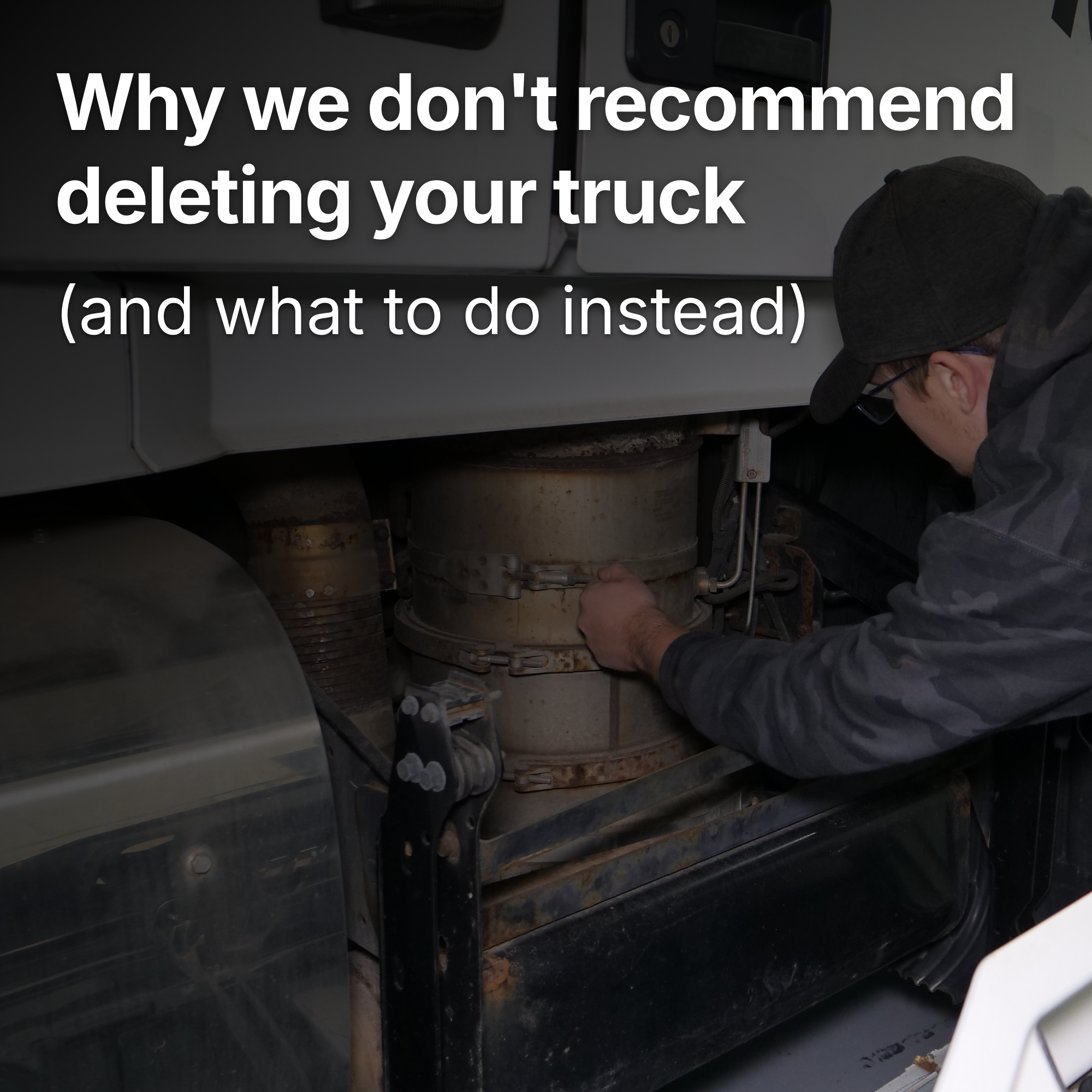
Deleting a truck means physically pulling or bypassing the emissions parts and then reflashing the engine computer so it runs without them. To understand why that bites you later, it helps to know what each part actually does. None of it is on the truck by accident.
- DPF (Diesel Particulate Filter) traps the soot in your exhaust so it doesn't go out the stack. It fills up over miles and has to be burned clean, which is what a regen does.
- DEF/SCR (Diesel Exhaust Fluid / Selective Catalytic Reduction) sprays DEF into the hot exhaust to turn NOx, the bad stuff, into plain nitrogen and water. The SCR catalyst is what makes that reaction happen.
- EGR (Exhaust Gas Recirculation) routes some exhaust back into the engine to keep combustion temps down, which is another way the truck holds NOx in check.
After the hardware comes off, the ECM gets a delete tune so the truck keeps running with all of that gone. It is permanent, and there's no cheap way back to stock. The catch is that these systems are tied together. Pull one and the computer still expects to see it, which is where the downstream trouble starts.
Why owner-operators think about deleting
It comes down to downtime. Every day the truck sits is a day it's not earning. And it's almost never one big failure that pushes a driver toward a delete. It's the same small fights, over and over:
- The truck keeps trying to regen and won't finish
- DEF quality faults that won't clear
- A NOx sensor that quits on you
- SCR efficiency codes
- The 5 MPH derate that strands you
- $400 to $500 dealer bills, every time
- Loads you lose while the truck sits in a bay
When the truck is parked instead of earning, deleting looks like the fastest way out. But over the life of the truck, it's rarely the cheapest. It just moves today's repair bill into tomorrow's legal, resale, and warranty trouble.
What a delete really costs you
The delete shop tells you the truck runs better and you'll never buy DEF again. What's not on their invoice is everything it can cost you later.
The up-front bill is real money
A DEF, EGR, or DPF delete plus the tune and labor usually runs $2,000 to $5,000. That's before the fine risk, the lost resale, and the cost to put it back to stock if you ever need to.
It's against federal law
Taking off or bypassing emissions parts is tampering under the federal Clean Air Act. The EPA counts it whether a shop does the work or you do. "Off-road only" doesn't make an on-road truck legal. This is general information, not legal advice, but the line is clear.
It can park you roadside
A lot of roadside inspections now read the emissions system, and programs like California's Clean Truck Check keep tightening. A deleted truck can get flagged, fined, and parked right there at the scale. One bad stop and you lose the load and the day.
The fines run into the thousands
The EPA can fine a driver for tampering, and California's CARB goes after drivers too. The numbers can run into the thousands per truck, and they can far exceed what a legitimate repair would have cost. The exact figures change, so check the current number, but either way it's a lot more than $399 a year.
It kills your resale
A deleted truck is a hard sell and a cheap trade. A lot of dealers won't take a tampered truck on trade, and private buyers are getting careful because putting it back to factory can cost thousands. You knock real money off what your truck is worth.
It can kill your warranty
Once you touch the emissions system, the engine maker can deny coverage on anything tied to it. You delete to skip a $400 to $500 reset, then eat a warranty claim worth ten times that.
The shop may be gone next year
The EPA has come down hard on delete shops with shutdowns and big settlements. The shop that tuned your truck may not be around when you need support. And a tampered truck can complicate an insurance claim when you need it most.
Why we tell drivers not to delete
OTR builds emission-intact diagnostics for a living. We don't sell deletes, we don't sell tunes, and we never touch your emissions hardware. Our whole reason for existing is to keep trucks on the road the legal way, clearing the same faults the dealer charges you for without ripping the system off the truck.
So when we tell you a delete is the wrong move, it isn't because we can't do the work. It's because we've watched what a delete costs drivers down the road, the fines, the failed inspections, the gutted resale value, and we built a better way to get you rolling.
So when we say a delete isn't worth it, that's not a sales pitch. Our whole business is keeping trucks on the road the legal way, fixing the truck and clearing the fault without ripping the emissions system off it. We don't sell deletes, we don't sell tunes, and we never touch your emissions hardware. We help you fix the truck and keep it legal, which is the opposite of a delete.
The better move: fix the problem, keep the system
So if a delete is the wrong answer, what's the right one? Most emissions faults have a root cause, and most of the time the truck doesn't need its emissions system ripped out. It needs the underlying issue repaired, then a command run from a diagnostic tool to bring it out of limp mode, the 5 MPH derate.
Take the 5 MPH derate, the one that strands you. That's not random. It's an inducement the engine maker built in on purpose. When the DEF runs low or out of spec, or the SCR system isn't cleaning NOx the way it's supposed to, the ECM steps the truck down to 5 MPH to force you to deal with it. On a Cummins that shows up as SPN 5246, the 5 MPH DEF derate. On a Volvo or Mack you'll see P-codes like P204F94 (SCR system performance / dosing failure) or P20EE00 (SCR NOx efficiency below threshold), and a soot-loaded DPF often throws P24A400 (DPF restriction). Those codes are the truck telling you exactly what's wrong.
Once the real issue is fixed, the bad sensor replaced, the DEF topped with good fluid, the clogged DPF cleaned or regenerated, the truck still won't always clear itself. The derate timer and the stored fault are still sitting in the ECM. That's the part the dealer charges you $400 to $500 for: running the command that clears the derate and forces the regen so the truck knows the repair is done. Do that, and you keep:
- DOT and CARB compliant, with the system intact
- Worth full resale value
- Ready for inspection with nothing to flag
- Out of federal tampering risk
A derate and a forced regen are normal service jobs. The dealer runs them every day with their factory tool. The difference is who runs them, and what it costs you.
How OTR Diagnostics helps
Instead of paying the dealer every time a light comes on, OTR Diagnostics puts dealer-level commands on your phone. It pairs with the included OTR Link 2 Bluetooth adapter, so you connect to the truck in minutes, in the lot, on your own clock. Everything below keeps the emissions system intact and the truck legal. Here's what each command actually does and why it fixes the problem.
Read OEM fault codes
Pull the real manufacturer codes, including Volvo and PACCAR P-codes, with plain descriptions. Before you spend a dime, you know whether you're chasing a NOx sensor, a dosing fault, or a plugged DPF. That's the difference between a guess and a repair.
See live engine data
Watch the values that tell you what the truck is actually doing: DPF soot load, DEF level, exhaust temps, NOx sensor readings, EGR position, boost, and more. If your soot load is high and your exhaust temps are low, that tells you the truck can't get hot enough to burn the filter clean, which points you straight at a forced regen.
Force a regen
A regen is how the DPF gets cleaned out. The truck raises the exhaust temperature high enough to burn the trapped soot down to ash. Normally the truck does this on its own (a passive or active regen) while you drive, but if it keeps getting interrupted or never reaches temp, the soot loads up and you get a derate. A forced DPF regen commands the truck to run that burn-off cycle on the spot, in the lot, until the filter is clean. OTR runs a forced DPF regen on all six engine platforms, no trip to the dealer.
Reset supported fault codes and aftertreatment
After you fix the underlying problem, the stored code and the aftertreatment counters are still in the ECM. Reset fault codes clears the supported inactive codes. Reset aftertreatment, reset soot level, and reset ash accumulator zero out the counters the computer uses to track how dirty the system is, so after a clean or a filter swap the truck isn't still acting like the old filter is plugged. You're telling the truck the truth about its own condition after the repair.
Run SCR and aftertreatment commands
The SCR side is where the advanced work lives, and it's engine-specific. On Volvo and Mack, OTR runs a forced SCR regen and DEF crystal sublimation, which heats up and clears the hardened DEF crystals that build up in the dosing system and choke it off. On Cummins, an SCR performance test checks whether the catalyst is actually converting NOx. On PACCAR, you can evaluate the SCR system (EPA17 and newer) and purge the SCR/DEF module. On Detroit, there's a forced SCR efficiency regen. The exact menu varies by engine, so check your platform in the table below. The point is the same: these put the dealer's aftertreatment toolbox in your hand.
Clear supported derates
On supported engines, you clear the derate (the technical term is exiting the inducement) after the underlying repair is done, with the emissions system left fully intact. Mechanically, this resets the 5 MPH derate timers in the ECM so the truck comes off limp mode once it sees the repair is complete. Which derates are supported depends on your engine platform, and we only claim what the tool really does. The full coverage is in the table below.
What OTR does on your engine
No overpromising. Here's exactly what it does, all the way through 2026 model-year trucks.
| Engine | Years | Clear derate | Forced regen | What it does |
|---|---|---|---|---|
| Volvo (D11/D13/D16) | 2014+ | Yes, clears the 5 MPH derate | DPF + SCR | Reset fault codes, reset aftertreatment, reset soot level, forced DPF regen, forced SCR regen, DEF crystal sublimation, reset the 5 MPH derate timers (exit inducement) |
| Mack (MP7/MP8/MP10) | 2014+ | Yes, clears the 5 MPH derate | DPF + SCR | Reset fault codes, reset aftertreatment, reset soot level, forced DPF regen, forced SCR regen, DEF crystal sublimation, reset the 5 MPH derate timers (exit inducement) |
| PACCAR MX (Kenworth/Peterbilt) | 2011+ | Yes, clears the EGR and 5 MPH DEF derate | DPF | Reset fault codes, reset aftertreatment, reset EGR derate, reset 5 MPH DEF derate, forced DPF regen, evaluate the SCR system (EPA17+), purge the SCR/DEF module, install a cleaned or new DPF |
| Cummins (X15/ISX/X12) | 2011+ | Yes, resets the 5 MPH DEF derate (SPN 5246) | DPF | Reset faults codes, reset aftertreatment, aftertreatment maintenance reset, filter-installation reset, forced DPF regen, SCR performance test |
| Detroit (DD13/DD15/DD16) | 2011+ | Resets and forced regen (derate-clear not claimed) | DPF + SCR efficiency | Reset fault codes, reset aftertreatment, reset ash accumulator, reset SCR accumulator, forced DPF regen, forced SCR efficiency regen |
| International A26 | 2017+ | Resets and forced regen (derate-clear not claimed) | DPF | Reset fault codes, forced DPF regen |
Here's how it breaks down: OTR clears the derate on Volvo, Mack, PACCAR (the EGR derate and the 5 MPH DEF derate), and Cummins (the 5 MPH DEF derate, SPN 5246), after the underlying repair, with the emissions system left intact. On Detroit and International, OTR runs the resets and forces the regen, and we do not claim a derate-clear on those, because we only sell what the tool really does. Forced DPF regen works on all six. Coverage starts at 2011 (Detroit, Cummins, PACCAR), 2014 (Volvo, Mack), and 2017 (International A26), and runs through 2026 trucks, including the brand-new ones most aftermarket tools can't touch. Not sure about your truck? Run the VIN and year check before you buy.
Delete it vs. clear it
Same problem on the side of the road. Two very different ways out.
| Delete / tune | Clear it with OTR | |
|---|---|---|
| Legal on the highway? | No, breaks the Clean Air Act | Yes, emissions stay on and DOT-legal |
| Up-front cost | $2,000 to $5,000+ | $399 a year, adapter included |
| Roadside and CARB checks | Can fail inspection, fine risk | System intact, nothing to flag |
| Resale value | Tanks it, costs money to undo | Truck stays stock, value kept |
| Warranty | Can be denied on related parts | No hardware touched, no added risk |
| Who does it | A delete shop, on their clock | You, from your phone, in minutes |
| Next time it happens | Permanent, no cheap way back | Do it again as many times as you need, no extra charge |
Get it on the truck before the next light
One honest thing: OTR runs on the OTR Link 2 Bluetooth adapter. You need the adapter in the cab and the app on your phone. If you're stranded right now and you don't have it yet, this isn't a tonight fix, and we won't pretend it is.
That's exactly why you set it up now, before the next derate. Get OTR in the cab today, and the next time the truck drops to 5 MPH, you handle it yourself in the lot in minutes. No tow. No dealer. No three days in a bay. So that tonight is the last time a shop holds your truck hostage over a derate.
More than 10,000 drivers already do it this way, backed by 729+ 5-star reviews and a 60-day money-back guarantee. Made in Detroit. They clear their own derates, force their own regens, and stay out of the dealer bay, with everything stock and legal.
Frequently asked questions
Is deleting a diesel truck illegal?
Yes. Taking off or bypassing the emissions controls (DEF, EGR, DPF, or SCR) is tampering under the federal Clean Air Act. It's illegal on an on-road truck whether a shop does it or you do. This is general information and not legal advice.
Can I clear a derate without deleting?
Yes. A derate, the 5 MPH limp mode or inducement, can be cleared the legal way with the emissions system left on the truck, after the underlying repair. OTR Diagnostics does this on Volvo, Mack, PACCAR, and Cummins (including the Cummins 5 MPH DEF derate, SPN 5246), from your phone with the OTR Link 2 adapter. On Detroit and International, OTR runs the resets and forces the regen.
Does OTR delete trucks?
No. OTR is not a delete shop. We don't sell tunes or delete kits, and we never touch your emissions hardware. OTR Diagnostics clears supported derates and forces the regen the legal way, with everything left stock and DOT-legal.
Will clearing a derate damage my truck or the emissions system?
No. Clearing a supported derate and forcing a regen are standard OEM service procedures the dealer runs every day with their factory tool. OTR runs the same real commands. Nothing is pulled or bypassed, the emissions system keeps doing its job, and the truck stays stock and legal when the commands are run after the underlying repair.
How much does deleting a truck cost?
A delete tune plus labor usually runs $2,000 to $5,000 up front, before the fine risk, the lost resale, and the cost to put it back to stock later. Clearing the derate legally with OTR Diagnostics is $399 a year, with the OTR Link 2 adapter included.
Is a delete worth it in 2026?
For most owner-operators, the math doesn't work. The EPA is cracking down hard on delete shops, roadside and CARB checks are tighter, and resale on a tampered truck is brutal. You'd spend $2,000 to $5,000 and take on federal risk to skip a $400 to $500 reset you can do yourself for $399 a year.
The bottom line
When you're stranded with a derated truck at 9pm, deleting feels like the fastest answer. In reality it usually creates bigger problems down the road, legal, financial, and at resale. There's a better move, and you run it yourself.
The better long-term move is simple: figure out what's causing the fault, make the repair, and use dealer-level commands to get rolling again with your emissions system fully intact. That's exactly what OTR Diagnostics puts in your hands. Don't delete it. Clear it.
For $399 a year you get the app, the OTR Link 2 Bluetooth adapter free (a $299 value), all six engine platforms, unlimited derate-clears and forced regens, and a 60-day money-back guarantee. That's less than one tow, and less than a single dealer reset. More than 10,000 drivers run it, backed by 729+ 5-star reviews. Made in Detroit. See what it does on your Volvo, Cummins, or any of the six covered engines, and set it up before the next light.
OTR Performance sells legitimate, emission-intact diagnostic tools. We do not sell, install, or support emissions deletes, defeat devices, or delete tunes, and we do not recommend tampering with any emissions control system. Clearing a supported derate and forcing a regen are standard service functions performed with the emissions system fully intact. Information here about laws, penalties, and enforcement is general, may change, and is not legal advice. Confirm current EPA and CARB requirements for your situation.
How Truck Diagnostic Tools Cut Emissions Downtime